
In previous blog posts, we’ve explained why microbial shake flask experiments are the lifeblood of biotech research. Most of the time, aerobic and fast-growing organisms are being used in (white) biotechnology because of their high productivity but these cultures usually come with a big appetite for oxygen.
This is especially critical on the shake flask level because with standard Erlenmeyer flasks, the oxygen transfer rate (OTR) is usually limited to roughly 60 mmol/h/l when using a 25 mm shaking diameter (5 % fill volume, 350 rpm) and around 70 mmol/h/l when working at 50 mm throw (5 % fill volume, 350 rpm). However, these shaking conditions require two things:
- Sophisticated (and expensive!) shaking incubators capable of operating at 350 rpm at 25-50 mm throw
- Very low fill volumes, which aren’t always practical—especially if the flask is part of a seed train and requires a certain volume
The result: Many labs struggle to run non-baffled flasks under bioprocess conditions that are suitable for aerobic fast-growing bacteria like E. coli, V. natriegens, Bacillus or even yeasts like Pichia. But these organisms are very relevant in the area of (white) biotech!
Why is this important?
Because every screening or process development step should be done having the larger production scale in mind! Meaning that, if possible, every small-scale experiment should ideally mimick the larger bioreactor conditions.
And while this is already tricky — since complex control mechanisms like active pH regulation or fed-batch strategies usually aren’t feasible at this scale — scientists should at least ensure sufficient gas transfer in their experiments. This challenge becomes even greater at the microtiter plate (MTP) level, but it’s also surprisingly easy to get wrong with shake flasks.
A common issue is that many molecular biologists aren’t deeply familiar with dissolved oxygen (DO) levels or oxygen transfer rates (OTRs), as these topics are typically handled by fermentation specialists in process development. The result? Gaps in understanding that can cause major problems when trying to translate shake flask results to stirred bioreactors during scale-up.
The Shake Flask Oxygen Gap
Using tools like the Kühner OTR Calculator, you quickly realize that “normal” shaking conditions (10–20% fill volume at 200–250 rpm) barely reach 10–20 mmol/h/l in non-baffled flasks. That’s not sufficient for common biotech workhorses and these organisms often experience a certain period of oxygen limitation. If oxygen is limited, fast growers like E. coli switch metabolic gears, producing overflow metabolites such as acetate, leading to less product yield and a pH drop that usually affects the experiment in a negative way, too — all while growth is already capped by oxygen scarcity.
Higher-tech systems like the BioLector or bench-top bioreactors can achieve OTRs above 100 mmol/h/l through baffled plates (so-called flower plates) or active gassing, but most labs simply don’t have the resources—or desire—to invest in these setups.
So what’s the workaround? Many simply turn to baffled shake flasks, which increase the liquid-to-gas surface area and boost oxygen transfer.
At some point, every process reaches the physical limits of oxygen transfer: Even large production bioreactors can only achieve an OTRmax of around 150–200 mmol/h/L. Pushing beyond this usually isn’t practical or necessary. But if we compare those numbers with the 10–20 mmol/h/L that many researchers get from non-baffled shake flasks under standard conditions, the gap is striking. Even when using extreme setups — such as 5% fill volumes at 350 rpm — non-baffled flasks rarely exceed 60–70 mmol/h/L, still far below bioreactor-level performance.
There are creative approaches to narrow this gap, but in practice, most researchers turn to baffled shake flasks. By increasing the liquid-to-gas surface area, baffles boost oxygen transfer without the need for prohibitively intense shaking conditions.
However, many labs simply cannot implement the extreme conditions often applied in academic settings, such as those pioneered at the Chair of Biochemical Engineering at RWTH Aachen University. After listening to our customers, we developed a solution: A DO chemosensor that works seamlessly with standard baffled flasks.
Until recently, monitoring oxygen in these flasks was a major challenge.
This matters because while some users have embraced the advantages of non-baffled flasks, the majority prefer to stick with their existing baffled setups — and until now, reliable DO monitoring in these vessels wasn’t possible. For the first time, researchers can directly measure whether their cultures still face oxygen limitations or confirm that their chosen flask and shaking conditions provide sufficient gas transfer.
Equally important: Baffled flasks have rarely been characterized in such detail. Publications with reliable OTR measurements for these vessels are almost nonexistent. Our solution finally makes it possible to bring clarity to a system that has long operated in the dark.
Why nanoparticles? A step beyond the DO Pill
When we first introduced our DO chemosensor for shake flasks, the concept was simple but powerful: A pill coated with fluorescent dye that provided a non-invasive optical readout of dissolved oxygen in the liquid phase. The idea was to give users a sensor they could just drop into their flask during preparation — no extra setup, no disruption to their workflow.
However, it quickly became clear that this design wasn’t ideal for baffled flasks. The pill would collide with the baffles during shaking, leading to unreliable measurements, mechanical stress, and sometimes severe abrasion. In some cases, measurements weren’t even possible at all.
But the core of the DO Pill concept — easy, plug-and-play oxygen monitoring — was too valuable to give up. So, we asked ourselves: What if, instead of a single macroscopic pill, we worked with microscopic chemosensors distributed throughout the culture?
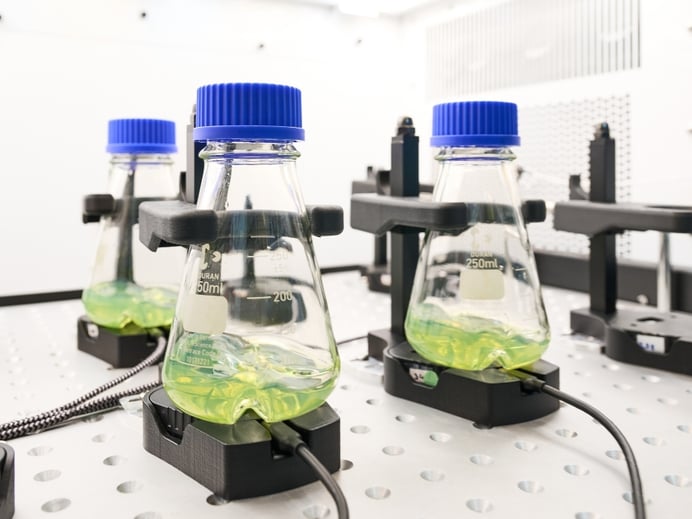
That’s how our chemosensor nanoparticles were born. Instead of relying on one larger pill passing by the Multiparameter Sensor (MPS), countless tiny nanoparticles are evenly distributed in the liquid phase, enabling continuous, reliable measurements.
And there’s another important benefit: With nanoparticles, the sensor is always in contact with the liquid. Unlike the pill, there’s no risk of accidentally measuring the gas phase in the headspace of the flask. In short, nanoparticles combine the ease-of-use of the pill with the robustness needed for baffled flasks.
Compatibility with different flask and baffle types
Because nanoparticles are not a macroscopic object that depends on the rotation of liquid within the flask, the concept works in virtually any shake flask under any shaking condition. This makes it especially well-suited for baffled flasks, but it can also be a valuable solution for non-baffled flasks when shaking conditions prevent the DO Pill from circulating smoothly.
In both our in-house tests and with external pilot customers, we’ve successfully evaluated a wide variety of baffled flask designs — from classic glass flasks with two to four baffles (side or bottom) to modern plastic versions such as the Thomson Ultra Yield Flask.
Some of these designs provided excellent oxygen transfer rates, while others introduced more “noise” into our backscatter biomass measurements. Still, the key takeaway is that across all these variations, the DO measurements with nanoparticles remained robust and reliable.
Online and offline biomass measurements
 Talking about biomass measurements, there is a slight drawback when using our nanoparticles: Even though the particles only have a size of roughly 200 nanometers, they do influence standard turbidity measurements like our scattered light monitoring with our MPS or classical offline optical density measurements. For offline OD measurements, this effect can be compensated by always adding the relevant concentration of nanoparticles, basically adjusting the blank. As for our scattered light readings, the sensitivity even for early growth and low biomass concentrations should not be influenced in a negative way, but a minor y-axis offset might be necessary when comparing a nanoparticle cultivation with one without particles.
Foaming and the role of antifoam
Another important aspect to consider is foaming. Baffled flasks tend to produce more foam, especially when complex media are used. While a thin foam layer can actually support oxygen supply by increasing the liquid–gas interface, excessive foaming has the opposite effect: It can completely block gas transfer.
From our perspective, foaming should always be kept under control, ideally minimized, as this not only improves oxygen availability but also helps generate smoother biomass curves in the MPS’s scattered light monitoring.
Interestingly, our DO nanoparticles appear to slightly increase foam formation. For this reason, adding antifoam is worth considering. That said, it’s important to note that foam does not interfere with the nanoparticle-based DO readout itself. So even in cases where antifoam cannot be used, reliable DO measurements remain fully possible.
Preparing and using the DO Nanoparticles
The DO Nanoparticles will be delivered to the customer as a freeze-dried powder in a small vial and can be easily resuspended with water to create a small stock solution which is enough for 50 ml of cultivation broth. This stock solution can then be added to the flask by regular pipetting, ideally when inoculating the shake flask under the sterile hood, so it is perfectly in line with standard laboratory workflows.
Of course, one vial can be used to equip several shake flasks with DO nanoparticles. For larger flasks with high fill volumes, it can also be necessary to add more than one vial per flask.
Downstream processing: Filtering out Nanoparticles
Most of the time, our customers use the DOTS Platform for characterizations and medium-throughput screenings or early process development. This means that the culture is often discarded afterwards because only the insights from that experimental run are important. In that case handling the nanoparticles is rather easy: Just dispose of them with the finished culture.
However, sometimes people want to include additional offline analytics on top of our online monitoring (e.g., HPLC measurements for substrate and product concentrations), so we chose a size for the nanoparticles (200 nm) that can be filtered out easily by using a 0,2 µm standard sterile filter or by centrifuging under recommended conditions.
As a result, selectively removing nanoparticles while preserving cells is not straightforward and may require additional process-specific strategies as cells and nanoparticles would sediment during centrifugation (even though the cells will sediment faster) and both would be retained by standard sterile filters.
Breaking the oxygen barrier in baffled flasks – Why this matters
For the first time in history, there now is an easy-to-use and commercially available system to monitor DO in standard baffled flasks without the need of gluing-in chemosensor spots and finicky alignment with the optical sensor. This breakthrough enables researchers to determine whether their baffled flask bioprocesses are truly optimized for oxygen demand or if limitations are still occurring, allowing targeted adjustments to avoid unwanted oxygen-limited conditions.
And even though professor emeritus Jochen Büchs from the chair of Biochemical Engineering at the RWTH Aachen University published quite a bit on negative aspects of baffles, some of them even being quite severe, we believe that baffles are a kind of “necessary evil” to overcome the oxygen limitations in non-baffled shake flasks.
Additionally, many modern, mechanically produced baffled flasks avoid the reproducibility issues that hand-made baffles were prone to. Our extensive DO data, collected through internal testing and with select pilot customers, confirms that oxygen limitation can be effectively overcome by using well-designed baffled flasks, appropriate fill volumes, and suitable shaking speeds.
With the right bioprocess conditions, we expect that oxygen transfer rates higher than 100 mmol/h/l are achievable with selected baffled flasks as previously reported, meaning a similar or even performance as the FlowerPlate. Those capabilities and knowing the actual dissolved oxygen concentration throughout the entire cultivation period further bridges the gap between the molecular biologists in strain engineering and the fermentation scientists in bioprocess development, bringing our DOTS platform another step closer to stirred bioreactors.